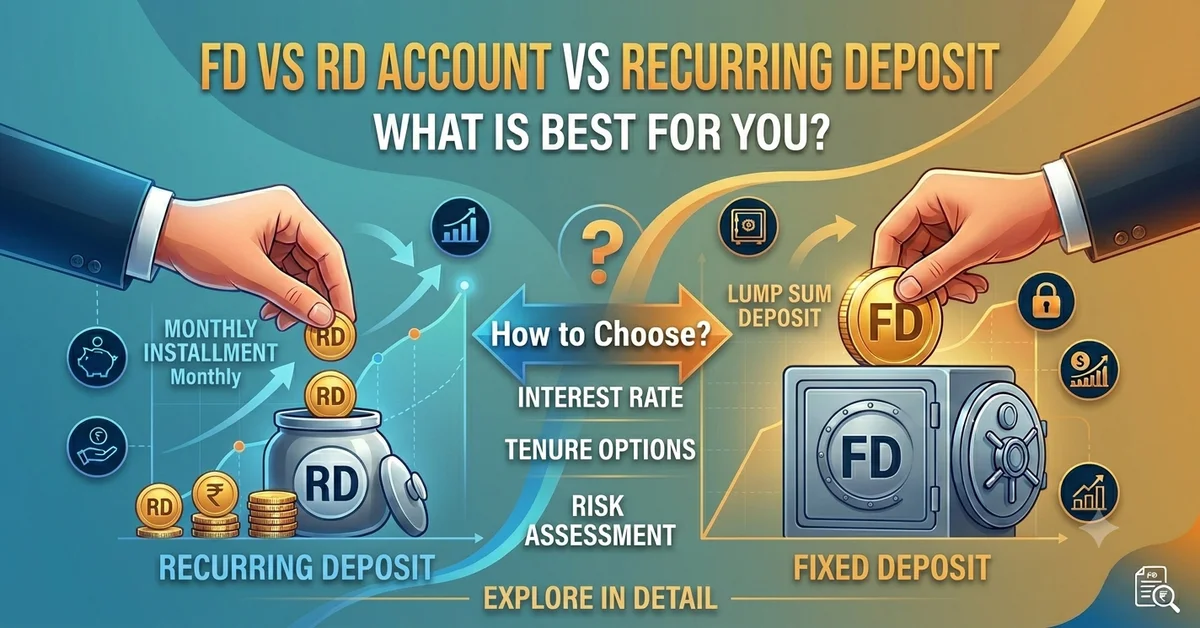
FD vs RD: When it comes to low-risk investments in India, Fixed Deposits (FD) and Recurring Deposits (RD) are the absolute go-to choices for almost every household. Both are backed by safety, offer guaranteed returns, and protect your hard-earned money from market volatility.
However, despite their similarities, they cater to completely different types of savers. The big question is: Where should you put your money? Let’s dive deep into a human-first analysis to help you make the right financial decision.
What is a Fixed Deposit (FD)?
A Fixed Deposit is designed for individuals who have a lump sum amount lying idle in their savings accounts. You hand over a specific amount to the bank for a predetermined period (tenure), which can range from a mere 7 days to a long 10 years.
In return, the bank locks in a higher interest rate than a regular savings account. This rate remains unchanged throughout your tenure, ensuring complete peace of mind. At maturity, you get your principal amount back along with the accumulated interest.
What is a Recurring Deposit (RD)?
A Recurring Deposit is built for disciplined, month-on-month saving. If you don’t have a massive chunk of money right now but can comfortably spare a fixed amount every month (like ₹1,000 or ₹5,000), an RD is your best friend.
Know more in Post Office FD Vs RD Accounts
You commit to depositing a fixed instalment every month for a chosen tenure (usually between 6 months to 10 years). The bank rewards your consistency with fixed interest rates that are often quite comparable to FD rates for similar tenures.
Side-by-Side Comparison: FD vs RD
To give you a quick bird’s-eye view, let’s look at how these two investment vehicles stand against each other:
| Criteria | Fixed Deposit (FD) | Recurring Deposit (RD) |
| Initial Investment | One-time Lump sum amount | Regular monthly instalments |
| Tenure Options | Highly flexible (7 days to 10 years) | Structured (6 months to 10 years) |
| Interest Rate Range | Generally higher (approx. 6% – 9% p.a.) | Slightly lower (approx. 3% – 8% p.a.) |
| Best Suited For | Individuals with sudden bonuses or windfall gains | Salaried individuals building a monthly corpus |
| Tax Saving Variant | Yes, 5-year Tax-Saver FD available (Sec 80C) | No specific tax-saving variant in regular banks |
The Real Truth About Returns: Interest Calculation Explained of FD Vs RD Account
Many investors make the mistake of assuming that if an FD and an RD offer the same 7% interest rate, they will yield identical returns. Mathematically, that is not true.
- In an FD: Your entire lump sum starts earning interest from Day 1. The compounding effect works on the full amount for the whole year.
- In an RD: Your first instalment earns interest for 12 months, your second instalment for 11 months, and your last instalment for just 1 month.
Therefore, even with the same interest rate, a Fixed Deposit will always generate a higher absolute return than a Recurring Deposit for the exact same amount invested over time.
Premature Withdrawals and Liquidity in FD Vs RD
Life is unpredictable, and emergencies don’t knock before arriving. What happens if you need to break your deposit?
- Breaking an FD: Banks allow premature withdrawals but will levy a small penalty (typically lowering your effective interest rate by 0.5% to 1%).
- Breaking an RD: You can stop instalments or withdraw early, but missed instalments might impact your final maturity amount and invite small penalties depending on the bank’s policy.
- The Smart Alternative: Instead of breaking your deposit, both FD and RD accounts allow you to take a Loan or Overdraft against them (up to 80%-90% of the value) at a very nominal interest rate premium.
Tax and TDS Guidelines to Keep in Mind
The interest you earn from both FD and RD accounts is fully taxable under your regular income tax slab.
- The TDS Threshold: If your total interest income across all deposits exceeds ₹40,000 in a financial year (extended to ₹50,000 for Senior Citizens), banks will automatically deduct 10% TDS.
- The Solution: If your total annual income falls below the taxable bracket, you can prevent this deduction by submitting Form 15G (or Form 15H for senior citizens) directly to your bank.
Final Verdict: Which One Should You Choose FD Vs RD Account?
The decision boils down to your current financial reality rather than just chasing the interest rates:
- Go for a Fixed Deposit if: You have a windfall lump sum (like an annual corporate bonus, inheritance, or property sale proceeds) and want a safe, predictable ecosystem to park it while earning premium returns. It is also an excellent option for senior citizens seeking regular monthly interest payouts to cover living expenses.
- Go for a Recurring Deposit if: You work on a monthly salary budget and want to cultivate an absolute discipline of saving. It helps you build a solid financial cushion incrementally for short-term goals like buying a vehicle, wedding expenses, or festive shopping without taking any market risks.
Conclusion: Making the Right Choice Between FD and RD
When wrapping up the FD vs RD debate, it is clear that neither financial instrument is universally superior; rather, they serve distinct saving behaviors. Your decision boils down to your current cash flow and investment habits.
If you have a lump sum of money from an annual bonus or windfall gains, locking it into a Fixed Deposit (FD) is the most efficient way to maximize your returns right from day one. On the other hand, if you operate on a strict monthly budget and want to cultivate an absolute discipline of saving, a Recurring Deposit (RD) allows you to build a substantial corpus incrementally without any financial strain.
Ultimately, both FD and RD accounts offer unparalleled security and guaranteed returns in a volatile market. By analyzing your short-term financial goals and liquidity needs, you can easily choose the product that perfectly aligns with your wealth-building journey.
—:::Frequently Asked Questions For FD Vs RD (FAQs):::—
Q1. Which is better for wealth creation: FD vs RD?
Ans: If you have a lump sum amount available right now, a Fixed Deposit (FD) is better because it calculates interest on the entire principal from day one, yielding higher absolute returns. However, if you want to build a savings habit from your monthly salary, a Recurring Deposit (RD) is the ideal choice.
Q2. Can I change the monthly instalment amount in my RD account?
Ans: No, once you select a monthly instalment amount at the time of opening a Recurring Deposit, it remains fixed throughout the entire tenure. If you want to invest more, you will need to open a separate RD account.
Q3. Is TDS applicable on both FD and RD accounts?
Ans: Yes, the tax rules are identical for an FD vs RD account. If your total interest income across all deposits in a bank exceeds ₹40,000 in a financial year (₹50,000 for Senior Citizens), the bank will deduct 10% TDS. You can submit Form 15G or 15H to prevent this if your total income is below the taxable limit.
Q4. Can I get a loan against my Fixed Deposit or Recurring Deposit?
Ans: Yes, almost all banks offer a Loan or Overdraft facility against both FD and RD accounts. You can typically get a loan of up to 80% to 90% of your accumulated deposit value at an interest rate that is just 1% to 2% higher than your deposit’s internal interest rate.
Q5. What happens if I miss an RD monthly instalment?
Ans: If you miss an RD instalment, banks usually levy a small penalty fee for that month. If you consecutively miss instalments for several months (usually 4 to 6 months depending on the bank), the bank reserves the right to close your RD account prematurely and return the balance with applicable penalties.