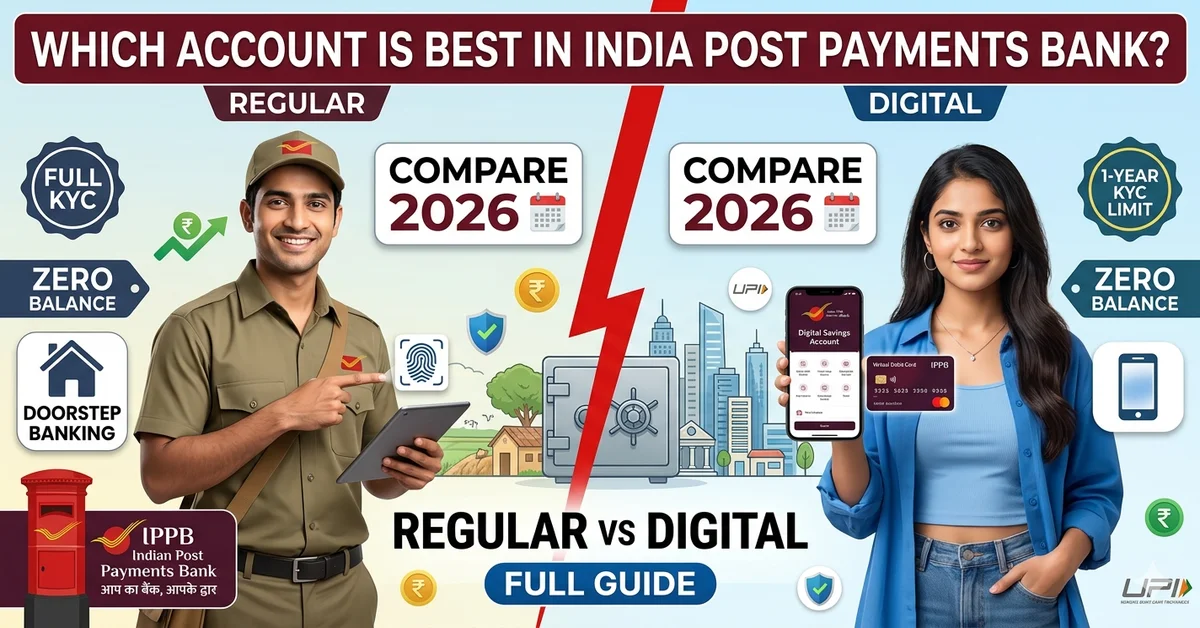
India Post Payments Bank: In today’s digital era, banking has shrunk right into our smartphones. When it comes to India’s most trusted and widespread government banking network, India Post Payments Bank (IPPB) stands at the very top. Combining the massive network of the Indian Post Office with modern digital technology, this bank has won the hearts of millions of Indians in a very short span of time.
हिंदी में पढ़ने के लिये यहां क्लिक करें
See This: SBI RD Close Online 2026 I एसबीआई का आर.डी. कैसे बंद करें
However, whenever a new customer decides to open an account with IPPB, the biggest question they face is—“Which account is best in India Post Payments Bank and why?”
If you are stuck in the same dilemma, this article is exclusively for you. In this comprehensive guide, we will dive deep into all IPPB account types, their features, hidden charges, and help you find the absolute best option for your needs.
What is India Post Payments Bank (IPPB)?
IPPB is a public sector bank operating under the Department of Posts, Ministry of Communications, with 100% equity owned by the Government of India. Its primary objective is to make banking services simple, accessible, and digital across every nook and corner of the country, especially in rural areas.
Since it is a Payments Bank, it comes with a few specific regulations and unique advantages. For instance, you can hold a maximum daily ending balance of ₹2,00,000 (2 Lakhs) in this bank, and it does not directly offer credit cards or loans. Despite these limitations, its seamless digital features and robust doorstep banking make it incredibly unique.
Types of Accounts Offered by IPPB
IPPB primarily offers three types of Savings Accounts:
- Regular Savings Account
- Digital Savings Account
- Basic Savings Bank Deposit Account (BSDA)
All three accounts have distinct features. Let’s break them down one by one to understand them clearly.
1. Regular Savings Account
This is the most popular and standard account offered by IPPB. It is ideal for individuals who want to enjoy the convenience of banking right from their home via a postman or by visiting a nearby post office branch.
Key Features and Benefits:
- Zero Balance Opening: You do not need to maintain any minimum monthly balance to keep this account active.
- Doorstep Banking: If you cannot visit the bank or post office, the postman (Gramin Dak Sevak) will come directly to your doorstep to facilitate cash deposits or withdrawals.
- Unlimited Deposits: You can deposit money as many times as you want throughout the year (as long as the daily ending balance does not exceed ₹2 Lakhs).
- Link with POSA: You can link this account to your existing Post Office Savings Account (POSA). The biggest benefit here is that any amount exceeding the ₹2 Lakh limit at the end of the day automatically sweeps out into your main Post Office account.
2. Digital Savings Account
This account is highly preferred by the younger generation and tech-savvy smartphone users. The standout feature of this account is that you don’t need to visit a post office or wait for a postman to get started.
Key Features and Benefits:
- Instant Account Opening: You can download the IPPB Mobile Banking App from your phone and open an account instantly within 5 minutes using just your Aadhaar card and PAN card.
- Virtual Debit Card: Upon opening the account, you instantly get a Virtual Debit Card that allows you to easily handle online shopping, mobile recharges, and utility bill payments.
- Complete Convenience: The entire process is 100% paperless and fully digital.
Important Note: A Digital Savings Account is valid for 1 year only. Within 12 months of opening the account, you must visit a nearby post office or complete your Biometric KYC (Full KYC) via a postman. Failure to do so will result in the account being frozen. Once full KYC is complete, it automatically upgrades to a Regular Savings Account.
3. Basic Savings Bank Deposit Account (BSDA)
This account is specifically designed for the economically weaker sections of society or individuals who require very minimal banking transactions.
Key Features and Benefits:
- Free Basic Services: Core banking features such as passbooks and account maintenance are provided free of cost.
- No Minimum Balance: Just like the other accounts, there is no stress regarding maintaining a minimum balance.
- Limited Transactions: This account only allows up to 4 free cash withdrawals per month (including ATM and counter transactions). However, there are no restrictions or charges on cash deposits.
India Post Payments Bank Accounts Comparison:
| Features / Account Type | Regular Savings Account | Digital Savings Account | Basic Savings Account (BSDA) |
| Account Opening Method | Via Post Office / Postman | Self-service via IPPB App | Via Post Office / Postman |
| Minimum Balance Required | ₹0 (Zero) | ₹0 (Zero) | ₹0 (Zero) |
| Maximum Balance Limit | ₹2 Lakhs | ₹2 Lakhs | ₹2 Lakhs |
| KYC Requirement | Instant (Biometric) | Within 1 Year (Full KYC) | Instant (Biometric) |
| Monthly Cash Withdrawals | Unlimited (Charges apply) | Digital via App | Only 4 Free Withdrawals |
| POSA Linking Facility | Yes, available | Available after Full KYC | Yes, available |
India Post Payments Bank Savings Account Interest Rates
How much interest you earn on your savings is always a critical factor. India Post Payments Bank offers a tier-based interest rate on all its savings accounts:
- For balances up to ₹1 Lakh: 2.00% per annum (Approx.)
- For balances above ₹1 Lakh and up to ₹2 Lakhs: 2.25% per annum (Approx.)
Note: Interest rates are subject to change over time, so it is highly recommended to check the official IPPB website for the latest rates. The interest is credited to your account on a quarterly basis.
Comparison: Regular vs Digital Savings Account – Which One is For You?
If we look at the main competition, the choice usually boils down to Regular vs Digital. Let’s see which scenario fits you best:
- If you need an account instantly: Suppose you need an account number immediately to receive a government subsidy or to receive an urgent fund transfer. In that case, the Digital Savings Account is your best bet. You can activate it instantly without stepping out.
- If you handle cash transactions frequently: If you prefer physical cash deposits and withdrawals, the Regular Savings Account is ideal. You get biometric security right from day one, and a postman can assist you right at your doorstep.
- For long-term hassle-free usage: Since the digital account eventually requires physical biometric verification within a year to avoid getting blocked, starting with a Regular Savings Account through a postman saves you an extra step down the line.
Final Verdict: Which Account is Best in India Post Bank and Why?
After evaluating all parameters, features, and limitations, our final verdict is clear:
The “Regular Savings Account” is the absolute best account in IPPB.
5 Main Reasons Why It’s the Best:
- No Risk of Account Freezing: Unlike the digital variant, there is no 1-year deadline hanging over your head to complete KYC. It is a fully validated, permanent account from day one.
- Seamless Post Office Account (POSA) Linking: Linking it to your main Post Office account is incredibly smooth. This effectively removes the ₹2 Lakh restriction, as any excess balance automatically sweeps into your post office account, which often yields better interest rates.
- True Doorstep Banking Experience: This account unlocks the true potential of Indian Post. You can request a postman to handle cash transactions, distribute funds, and pay utility bills right at your home—a massive blessing for senior citizens and rural areas.
- Direct Benefit Transfer (DBT) Support: Government subsidies, student scholarships, and benefits like PM-Kisan flow into this account smoothly via Direct Benefit Transfer without any technical glitches.
- Enhanced Biometric Security: Because your biometric thumbprint is registered at the time of opening, the risk of digital fraud, identity theft, or unauthorized access is practically eliminated.
Documents Required to Open an IPPB Account
If you have made up your mind, getting started requires minimal paperwork:
- Aadhaar Card (Must be linked to an active mobile number for the digital account registration process).
- PAN Card
- An active mobile number
Conclusion
India Post Payments Bank (IPPB) has successfully brought reliable banking to the doorstep of every Indian. If you are entirely independent and looking for an instant fix, you can start your journey with a Digital Account. However, for a permanent, highly secure, and restriction-free banking experience, the Regular Savings Account stands out as the smartest and most reliable option.
So why wait? Walk into your nearest Post Office or get in touch with your local postman to open your preferred account with India’s very own bank today!
Frequently Asked Questions For India Post Payments Bank
Q1. Is it mandatory to maintain a minimum balance in an IPPB account?
Ans: No, there is absolutely no requirement to maintain a minimum monthly or average balance in IPPB Regular, Digital, or Basic savings accounts. They are entirely zero-balance accounts.
Q2. Can I use Google Pay, PhonePe, or Paytm with an IPPB account?
Ans: Yes, you can easily set up UPI applications like Google Pay, PhonePe, Paytm, and BHIM by using the Virtual Debit Card provided inside the IPPB Mobile Banking application.
Q3. What is the primary difference between a Digital and a Regular account?
Ans: A Digital Account is opened by yourself using the mobile application and remains valid for only 1 year until full KYC is done. A Regular Account is opened via a post office official or postman using biometric authentication and is valid for a lifetime.
Q4. What is the maximum amount of money I can keep in my IPPB account?
Ans: As per payments bank guidelines, the maximum end-of-day balance limit is ₹2,00,000 (2 Lakhs). To store more than this limit, you must link your IPPB account to a standard Post Office Savings Account (POSA) for automatic sweep-out.